AI Is Stress Testing Your Operating Model

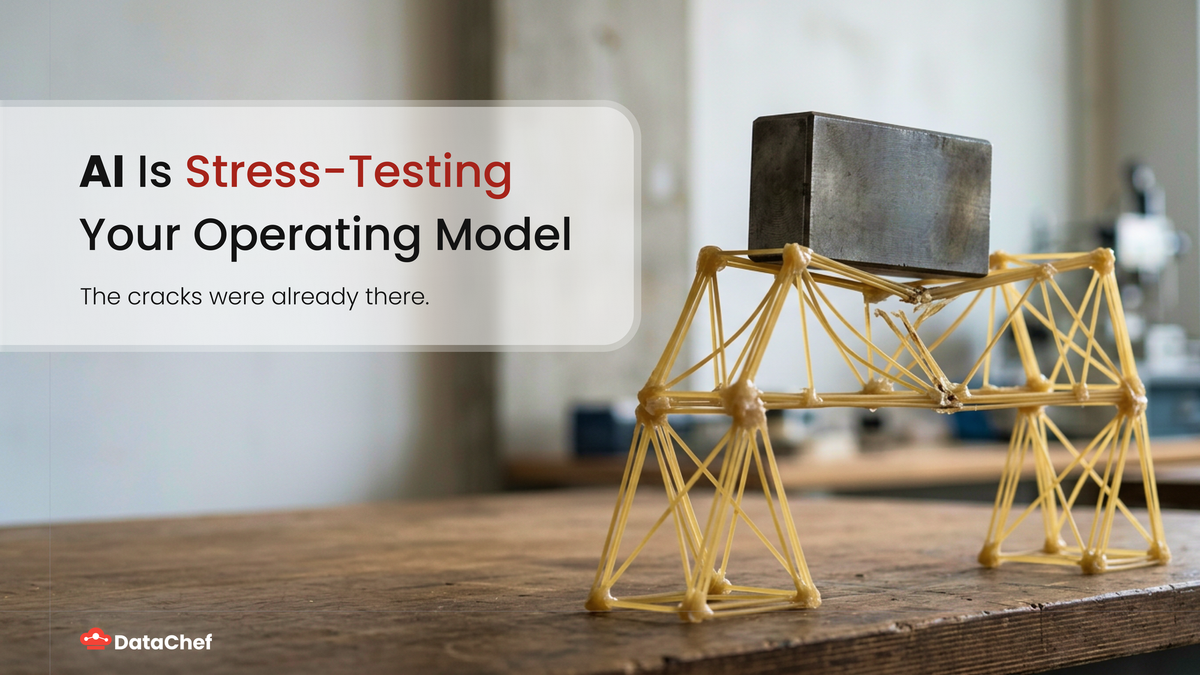
AI is becoming a stress test for the way organizations operate. Now that the dust is settling, we're starting to see the effects of adopting AI across companies. There are some success cases, and also plenty of walkbacks. Many organizations are questioning the efficiency gains as promised by the AI marketing ads. Folks are doubting whether the technology lives up to what the news and social media projected.
I believe the answer sits somewhere in between the walk-backs and the hype. On one side, we shouldn’t throw the baby out with the bathwater: as with any technological advancement, organizations need to understand how to integrate the technology into their products and their business operations. On the other side, problems start when people just kick the can down the road, hoping for the best. Hope is not a strategy.
The stress is not only technical. AI adoption is exposing the gaps in the operating model.
Teams are changing by bringing AI agents into their workflows: they delegate tasks to those agents, freeing up time for other high-value work that couldn’t be done before. It is the same paradigm as before: cheaper, easier-to-consume capability tends to increase use, not decrease it. Economists call this the Jevons paradox. But this clashes with the status quo, where organizations have rigid decision-making processes and long chains of approvals. Teams don’t have agency and a clear mandate. One could say companies remain output-oriented rather than outcome-oriented. Exactly the same mindset the Industrial Revolution ran on.
To get the most out of AI, organizations need to invest in effectiveness before they invest in efficiency.
Effectiveness has several facets, ranging from a single team to a group of teams under a department to the whole organization. As AI gets integrated, it changes internal workflows as well as the services and products organizations offer the market. Teams need to adapt quickly. For that, they need direction from management on where to place their bets, and, at the same time, the room to safely experiment and understand the effects of the changes they’re making.
This is one trait of outcome-oriented organizations: different levels of the organization operate on different timeframes, without forcing each other to move at the same pace. They minimize and automate bureaucracy, freeing up time to focus on core activities.
One recent example from my consultancy experience was with an organization that was very explicit about where they were deploying AI in their SDLC workflow. Rather than “go and use AI”, they started with smaller experiments to understand where they could reduce the friction in the process and be more effective at creating software.
Those experiments were around product prototyping and code refactoring. Part of their success came from reusing capabilities they already had in their internal platforms, such as their design system and the tooling supporting their CI and CD practices. They started with a handful of pioneers to shape how the new AI capabilities fit into the platforms. They already had historical metrics the teams used, so as they adopted AI, they could look back, retrospect, and change course.
The interesting part was how they leveraged the FinOps capabilities already in their internal platform. Since the organization's services already ran in the cloud, they had a fine-grained view of their cloud costs. That gave teams visibility into AI costs too, so they could weigh the quality of the AI output against its cost. They weighed process changes carefully and made them at the right level: by the teams that actually use and maintain those processes.
This is the operating model being tested. Not in theory, but through teams' daily work. Where is the mandate? Where are the boundaries? Where does the decision happen? Where is the feedback loop? Where does the cost become visible? Where does the learning change the process?
Another example from the field comes from IKEA. They integrated AI into customer support, delegating repetitive tasks to AI agents. But rather than doing AI substitution and firing those human agents, they started a training program and reskilled those people to handle other tasks that management deemed higher value. This is the poster child for effectiveness, and efficiency is a side effect.
It’s about learning! It has always been!
The heading says it all. Organizations with learning loops in place embed AI more easily than their peers. They can also tell when AI isn't a good fit and roll back instead of keeping going (the famous sunk cost fallacy).
What I’m observing in the field, working with my customers, is that organizations that invested in shaping their platforms naturally created these learning loops and can now leverage them to integrate new technologies. In turn, they keep evolving their operating model, rather than taking big revolutionary steps.
This is also what I dig into in my masterclass, Designing Adaptive and Effective Organizations, if you want to go deeper on how to evolve the model rather than just patch around it.
And in your organization, how do you know when it is time to evolve your operating model?