Your Team Finished the Training. Nothing Changed. Here's Why.


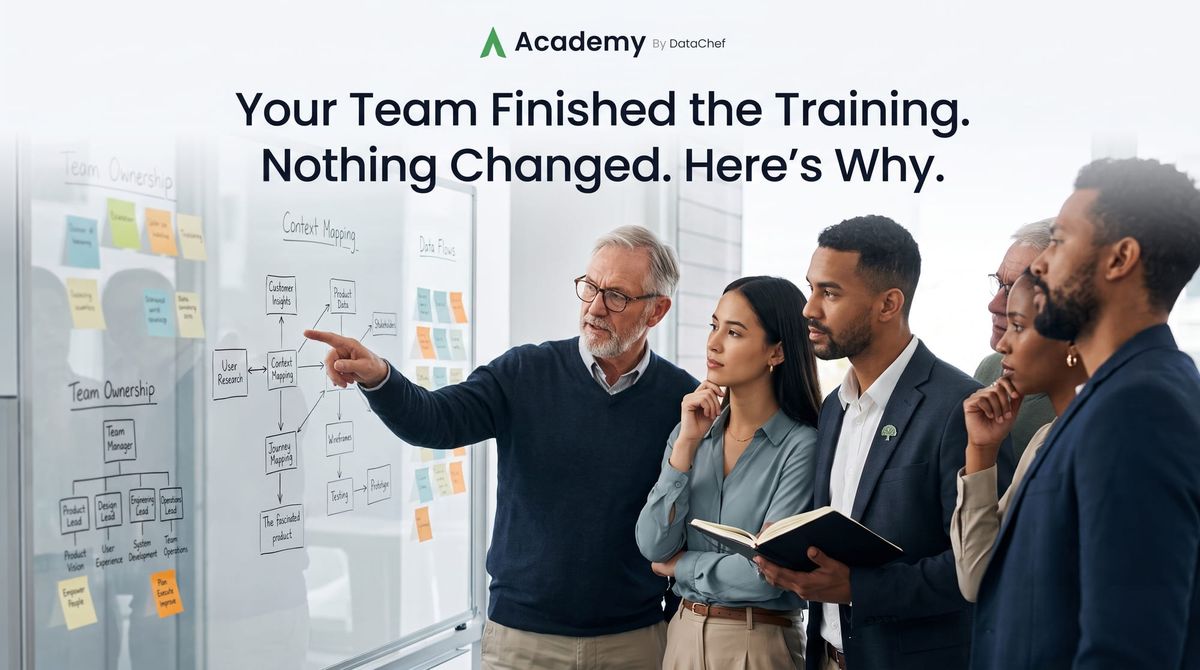
A senior data analyst spends two days at a workshop. She comes back with a certificate and a head full of new terms - data contracts, domain boundaries, the whole vocabulary. Three months later, she's doing the job exactly the way she did before. The certificate is on LinkedIn. The notes are in a drawer somewhere.
Most people who run L&D budgets have seen this enough times that it barely registers as strange. The easy explanations (she didn't apply herself, training doesn't stick) usually miss the real reason. Most training companies don't love talking about it: who's standing at the front of the room.
Curriculum vs. craft
Most professional training is built to scale: standardized materials, professional facilitators, content sanded down until it doesn't offend anyone, covering the concept and the vocabulary and the framework, rarely getting into when the framework breaks. That last part is missing because the person teaching it has never been in the room when it did.
Someone who has read the EventStorming literature can run the process. Someone who has run it in a room where the engineering lead doesn't trust the product team, and the product team doesn't trust the data, knows what the job actually is. The judgment is what you were actually paying for. When to push, when to let an uncomfortable silence sit, how to get a room talking again after it's gone quiet.
Most training companies hire trainers. Nothing wrong with that - it's just a different job. Someone can be very good at delivering someone else's curriculum without ever building the judgment your team actually needs.
What capability actually looks like
Capability is knowing when to use a concept, when to bend it, and when to leave it alone.
A capable data team knows when to propose a data contract, when to negotiate its edges, and when the organization isn't ready for one yet. Same idea at the leadership level: AI literacy means knowing which questions to put to a vendor, what claims deserve skepticism, and what risk you're actually signing up for.
When a data engineer and a product manager use the same words for domain boundaries and ownership, decisions stop bouncing between them. A disagreement that used to cost five Slack threads and a meeting gets settled in a ten-minute conversation. That shared vocabulary is a form of capability in its own right.
That kind of transfer comes from practitioners telling you how they actually think, including the parts they got wrong and would do differently now - not from a facilitator running standardized material.
What the gap costs while it stays open
Training that doesn't transfer still costs money: the days out of the office, the licensing fees, the good intentions that fade by Friday. But the bigger cost is what keeps happening in its absence.
Decisions keep escalating that shouldn't. When a team doesn't trust its own judgment, everything moves up a level. Leaders who don't have the bandwidth for operational calls end up with a backlog of them. Work stalls, not for strategic reasons, but because capability is spread unevenly across the org.
Data and AI initiatives stall out at "interesting." Plenty of organizations want to move on AI and can't, because the people closest to the work don't have the language to connect it to a business outcome. Enthusiasm without vocabulary produces a lot of pilots and very few results.
Good people leave. Senior technical staff who don't see a real path to grow will find one somewhere else. A training program that's obviously a box-tick tells them exactly how much the organization values their development, and they read it correctly.
We never planned to be trainers
DataChef Academy started as a side effect. DataChef, the consulting company, does implementation work: data foundations, AI systems, operating models that have to survive contact with an actual organization. At the end of an engagement, we'd run a knowledge-transfer program to make sure that the team that stays can take over operations from us. The feedback kept coming back the same way: those sessions were the most useful part of the whole project.
So we started asking why we were keeping it behind a consulting engagement at all.
The instructors still consult. They still run into the problems they teach. If something falls flat in a session, it doesn't make it into the next version of the course. And every course in the catalog comes from a specific problem we hit with one or more clients.
Courses built from real problems
- AI Leadership: The AI Integration Roadmap - for C-suite executives and senior managers who need to lead AI adoption without relying on bottom-up experimentation. Half-day, in-person.
- Designing Adaptive and Effective Organizations - for executives reworking their operating model with value streams, Team Topologies, and Beyond Budgeting. 2 days, in-person.
- Data & AI Product Management Certification - for senior data analysts ready to operate as a Data Product Manager. You leave with a finished Data Product Canvas. 1 day, in-person.
- Discovery Workshops: Reveal Hidden Complexity - EventStorming and Context Mapping for teams that need a shared picture of the problem before they build anything. Half-day, in-person.
- Flow of Value: Awareness Sessions - for whole teams. Helps people name what's slowing them down and take one clear next step. 4 x 2 hours, online.
Training you can use on Monday
If your team has already been through this cycle once, certificates out, behavior unchanged, you don't need us to oversell the problem. You've lived it.
We work with organizations across Europe, in person, in teams of 5 to 20. Every engagement starts with a conversation about the actual gap, not a sales call. We're practitioners first, and we'd rather tell you our course is wrong for you than run you through a program that won't land.
If that sounds like the kind of organization you want to work with, we'd like to talk.
DataChef Academy builds courses that survive the next reorg. Deep, durable, and built by practitioners who still ship. Browse the full catalog →