Your Next SAFe Teammate Might Be an Agent. What Job Will You Give It?

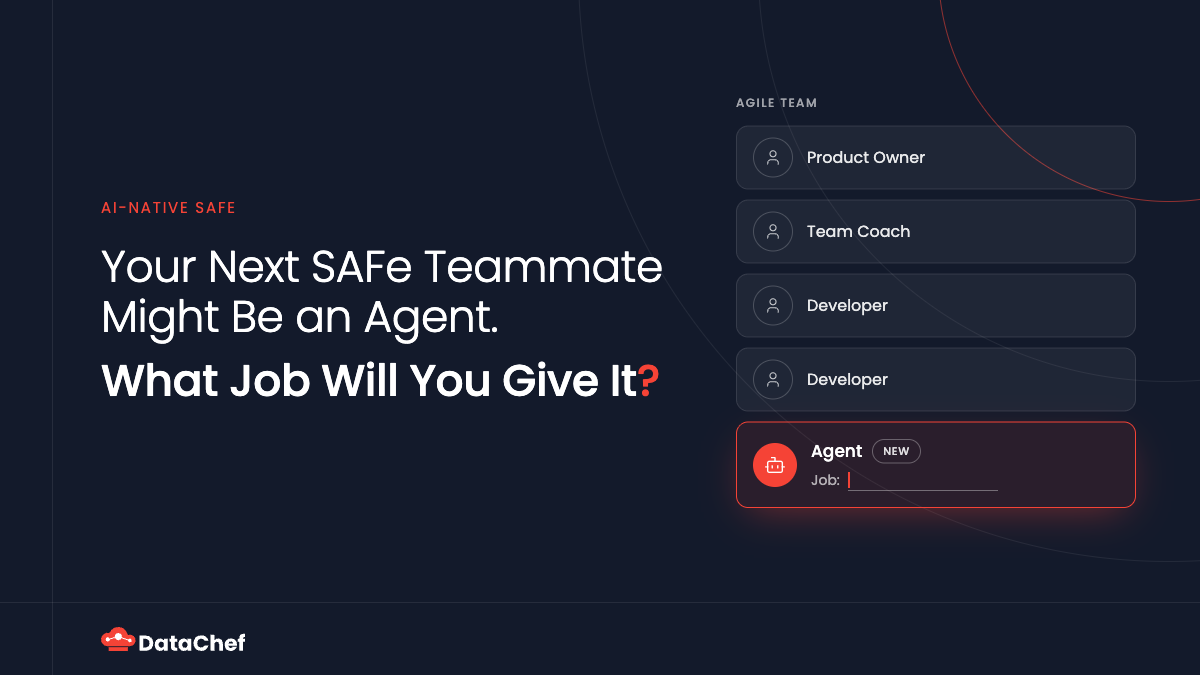
An AI agent joins your development team. You give it permissions to read the repository, propose changes, and run tests while everyone else is in a meeting.
By Friday, it has opened 20 pull requests. 14 of them need explanations, corrections, or someone to work out whether the problem needed solving in the first place. Your senior engineers spend the afternoon sorting through them.
Would you call that a successful first week?
For teams practicing SAFe, this question is getting harder to avoid. Scaled Agile introduced AI-Native SAFe in June 2026, bringing AI into the operating model rather than treating it as a tool someone uses on the side. Its AI-Native Teams guidance puts AI alongside the team’s human capabilities. In practice, an agent becomes something like a new colleague, while people stay accountable for the results.
What SAFe doesn’t tell you is how to start. Its new adoption roadmap explains how to launch AI-Native Agile Release Trains (ARTs), but it can’t choose your team’s first agent workflow. Each team still has to make that call.
Before an agent joins the workflow, the team needs answers to five questions:
- What should we give an agent first?
- How much access and autonomy should it have?
- Do we need several agents, or would one do the job?
- Who checks the output?
- How will we know whether this improved anything?
Give the first agent a job at the bottleneck
The tempting starting point is a tool demo, where an agent builds a feature in minutes. But that plays a bit too much to the strengths of our new "teammate". We would start somewhere less impressive: where does useful work get stuck?
If developers spend hours understanding failed builds, a read-only triage agent might help. If routine technical debt keeps getting postponed, a coding agent could take on small refactors under review. If pull requests already arrive faster than engineers can assess them, another code generator could make things worse. That is the trap from the opening scenario: cheaper code creates more work for the people who have to understand and accept it. We have written about that review bottleneck before. An agent that helps reviewers find the relevant context may be worth more than one that writes another feature.
Decide which capability needs strengthening before you choose the agent. Then look for work the team knows how to assess. A good first task has a bounded scope and an observable result, and a mistake should be cheap to undo. If nobody can explain what a good result looks like, the task isn’t ready to delegate.
Take a small refactor flagged by a static-analysis tool the team already uses. The agent inspects the finding, proposes a plan, and makes the change in an isolated branch. It runs the agreed checks and fixes what they reveal, within a retry limit, and a developer reviews the result before merging.
A coding agent can be your first agent. It just needs a smaller job than the demo suggests.
Let authority grow with evidence
There is no universal sequence in which every development team must adopt agents. A team with reliable tests may be ready for bounded code changes. Another may get more value from read-only investigation while it improves its checks. What should grow gradually is the agent's authority.
Microsoft's orchestration guidance recommends least-privilege access: give agents only the permissions their task requires. An agent that explains a failed build needs access to logs and relevant code. It does not need permission to change production. An agent that drafts a dependency update may need to edit a branch and open a pull request. That does not mean it should merge its own work.
Before the pilot starts, make those boundaries explicit:
- What can the agent read or change?
- Which checks must pass before its work reaches a reviewer?
- Who owns the result, and when must the agent stop and ask them for help?
Log what the agent did and which checks failed, cap its retries so a hard task can’t become an expensive loop, and plan the rollback before the first bad change.
Widen its access only when repeated runs show that it saves the team work, rather than moving the work somewhere less visible, and the team can explain why its accepted changes were safe.
Do you need a “super agent”?
Once several agents are involved, something has to keep track of the work, and that’s where the idea of a “super agent” usually comes in.
The useful version is an orchestrator: an agent that owns the plan for a bounded task and coordinates the agents or tools needed to complete it. Imagine a team evaluating a dependency upgrade across several services. The orchestrator identifies the affected services, gives each worker a defined scope, and gathers the changes for integration checks. If two workers need to change the same shared interface, it resolves the conflict or escalates it to a person. A worker reporting “done” doesn’t mean the combined result is ready, so the plan ends with a separate check against the team’s acceptance criteria.
That is coordination, not product leadership. An orchestrator does not decide which customer problem deserves investment. It does not replace the Product Manager or Release Train Engineer. People still set priorities and own the release decision.
Naming one agent “the boss” doesn’t fix coordination; clear ownership of each task does.
Three orchestration patterns from the same Microsoft guide are especially useful for development teams:
A sequential workflow fits work with a predictable order. An agent investigates a failed build, produces a structured diagnosis, and passes it to a remediation step. The handoff should include the evidence and what remains uncertain. Otherwise, the next stage may confidently act on a bad assumption.
Concurrent agents make sense when work can genuinely happen independently. Separate investigations into different services can run in parallel. Several agents editing the same tightly coupled module usually cannot, at least without considerable coordination.
A maker-checker loop gives one agent the work and another the job of checking it. This is useful when the checker has concrete criteria and appropriate tools. Two agents agreeing that code looks good is weak evidence. Running the required tests and reporting every failure is much stronger. Keep the checks protected from changes that would let the agent make its own work appear successful.
A handoff transfers ownership when a different specialist is needed. A triage agent might pass a security finding to a restricted security workflow, or to a person. Put a limit on transfers so the task cannot bounce between agents indefinitely.
An orchestrator-led workflow is useful when the path is less predictable and the plan needs to change as results arrive. It also creates more opportunities for mistakes in task breakdown, so it needs more careful evaluation.
Picking the most complicated pattern doesn’t make a team more advanced. Neither does copying the human org chart. A planner agent, developer agent, tester agent, and reviewer agent sounds familiar, but those stages often need the same context, and each handoff risks losing the reasons behind a decision. Anthropic recommends splitting work by context boundaries rather than by role. An agent implementing a contained feature should usually write its tests too, and a separate verifier can then run independent checks.
Whether more agents help depends on the shape of the work. In a study by researchers from Google Research, Google DeepMind, and MIT, every multi-agent setup did worse than a single agent on step-by-step planning, while central coordination helped on financial reasoning that splits into separate subtasks.
So add another agent when it solves a specific problem, such as isolating a large investigation or checking a result independently. If you can’t name the problem, one agent with a few tools will be easier to test and maintain.
Don't mistake generation for delivery
The opening scenario has a familiar failure: the agent is measured by what it produces, while the team pays for everything it produces that cannot be used.
More pull requests can mean more waiting. More prototypes can mean more unfinished commitments. Even passing tests may tell you little about whether the change was worth making.
This is how a team ends up maximizing garbage generation. Its dashboard rewards activity, while engineers absorb the cost of sorting out the results.
Keep agent work small enough to review. Limit how much it can put into the queue. When review capacity is exhausted, the generator should stop adding work rather than congratulate itself on another busy day.
Measure the pilot against the workflow it was meant to improve. Track time to an accepted change, including review and rework. Watch defects and rollbacks. Compare cost per accepted result with the baseline, including the human effort needed to reach it.
The customer or business outcome still matters. An agent can efficiently complete work that should never have entered the backlog.
Our approach to using Claude at DataChef starts from a simple rule: the developer owns the code. That responsibility does not disappear when the tool becomes more autonomous or starts delegating to other agents.
Make the strategy concrete enough to test
For a SAFe enterprise, the next move does not have to be a rollout across the whole ART. Choose one team and one workflow where the pain is visible. Establish the baseline before changing it, and agree on what would justify continuing, expanding, or stopping the pilot.
This is where DataChef can help. We work with teams to identify the first useful agent workflow and choose the architecture it actually needs. We define access boundaries and build evaluations around the work the team must accept. The pilot then tests whether those choices hold up in the team's own environment.
As João Rosa wrote in AI Is Stress Testing Your Operating Model, organizations need room to experiment and feedback loops that let the learning change the process. Agent adoption tests those conditions quickly. A missing approval boundary becomes a practical problem the moment an agent starts acting.
AI-Native SAFe gives practitioners a reason to have this conversation. Before you introduce your new colleague, decide which job would make the team’s week better.