Introducing SiteCraft: Prescriptive Location Intelligence for Multi-Location Businesses

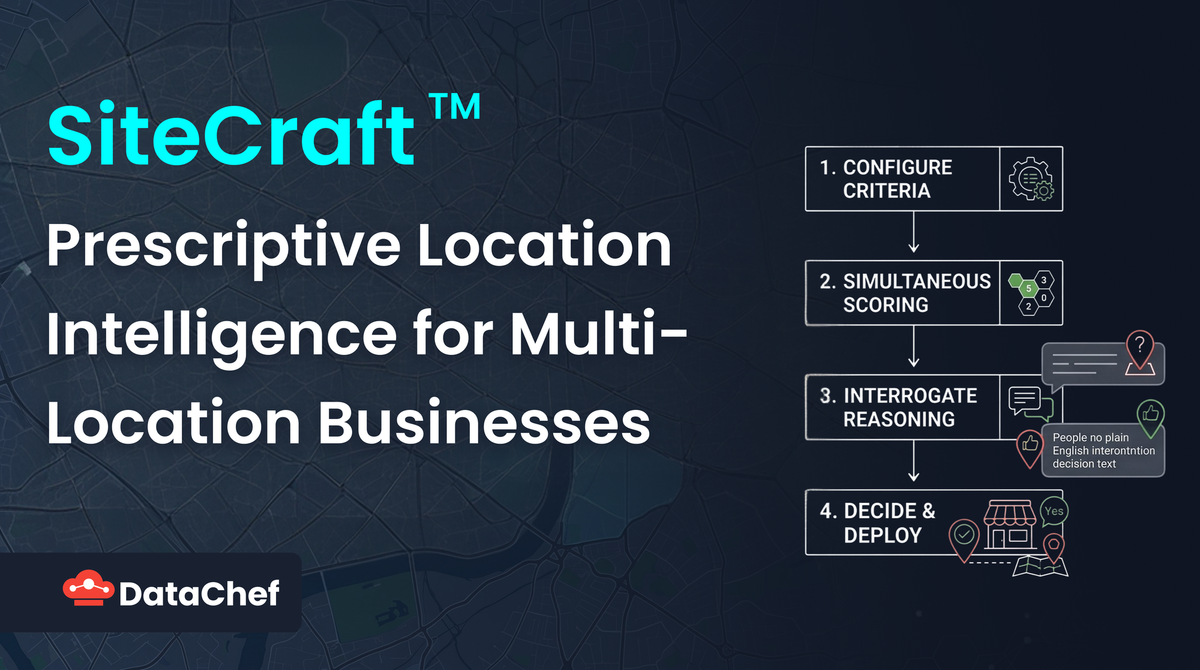
Imagine your best location consultant could evaluate every candidate site simultaneously, explain every recommendation in plain English, and update its thinking the moment your strategy changes. That's SiteCraft. Built by DataChef, SiteCraft is a prescriptive location intelligence platform that tells multi-location businesses not just where they could open next — but where they should, and why.
No more gut calls made in a vacuum. No more black-box optimization outputs. Just ask SiteCraft where to open next — and it will show you exactly how it got there.
The Problem: One Decision, Millions on the Line
Every year, retail chains, franchise operators, and F&B groups spend months — and millions — answering one question: where should we open next?
The process looks something like this. You hire location consultants. You buy demographic datasets. You run spreadsheet models. And at the end of it all, you still make a gut call.
This isn't irrational. The gut call exists because the data doesn't account for everything that matters — the brand's identity, the operator's read on a neighbourhood, the lease terms that make a great location suddenly unviable. The data gives you facts. It doesn't give you a decision.
And the stakes are real. A three-year lease signed on bad data is not a bug you can patch in the next sprint. A flagship store opened in the wrong district is not a failed experiment you can roll back. These decisions carry real consequences that compound for years.
The problem isn't a shortage of data or analysis tools. It's that none of them are built to help you make the decision. They give you better questions, not better answers.
Why Existing Tools Don't Solve This
You might think: "We already work with a consultant" or "We have a data platform for this." The reality is that most multi-location businesses have tried several approaches, and they all fall short in the same way.
Location consultants bring expertise and market intuition, but they're expensive, slow, and their analysis is a snapshot in time. Hire them in Q1 and their recommendation may already be outdated by Q3. And when you ask "why this location?", you get a slide deck — not a model you can interrogate or rerun.
Demographic and foot traffic datasets are valuable inputs, but context-free by design. They don't know your brand, your existing store network, your CapEx ceiling, or the fact that you already have three locations in the eastern district and a fourth would cannibalize them. A dataset gives you rows and columns. It doesn't give you a recommendation.
Optimization engines are powerful but completely opaque. You feed in your variables, and the engine returns an answer. The answer might be right. You have no way of knowing, because you don't know how it got there. If the inputs were wrong, or the objective function didn't capture what you actually care about, the output will be confidently wrong — and it won't tell you.
GIS and mapping tools show you where things are. They don't tell you what to do about it. You zoom in, draw a polygon, export a CSV, and hand it to someone else to interpret.
The common thread? None of these approaches produce a recommendation you can act on, explain, and defend in a board meeting.
What is SiteCraft?
SiteCraft is a prescriptive location intelligence platform that tells you where to open next — and shows you exactly why.
It combines live geospatial scoring, a configurable multi-signal optimization model, and a conversational AI agent into a single reasoning surface. You define what matters to your business. SiteCraft scores every candidate location against it, ranks the results, and makes the reasoning behind every recommendation fully transparent — so you can interrogate, adjust, and act with confidence.
Think of it as a consultant who has evaluated every candidate site simultaneously, remembers every constraint you've ever given them, and can explain every recommendation in plain English at any moment.
How SiteCraft Works
1. A Map That Reasons, Not Just Displays
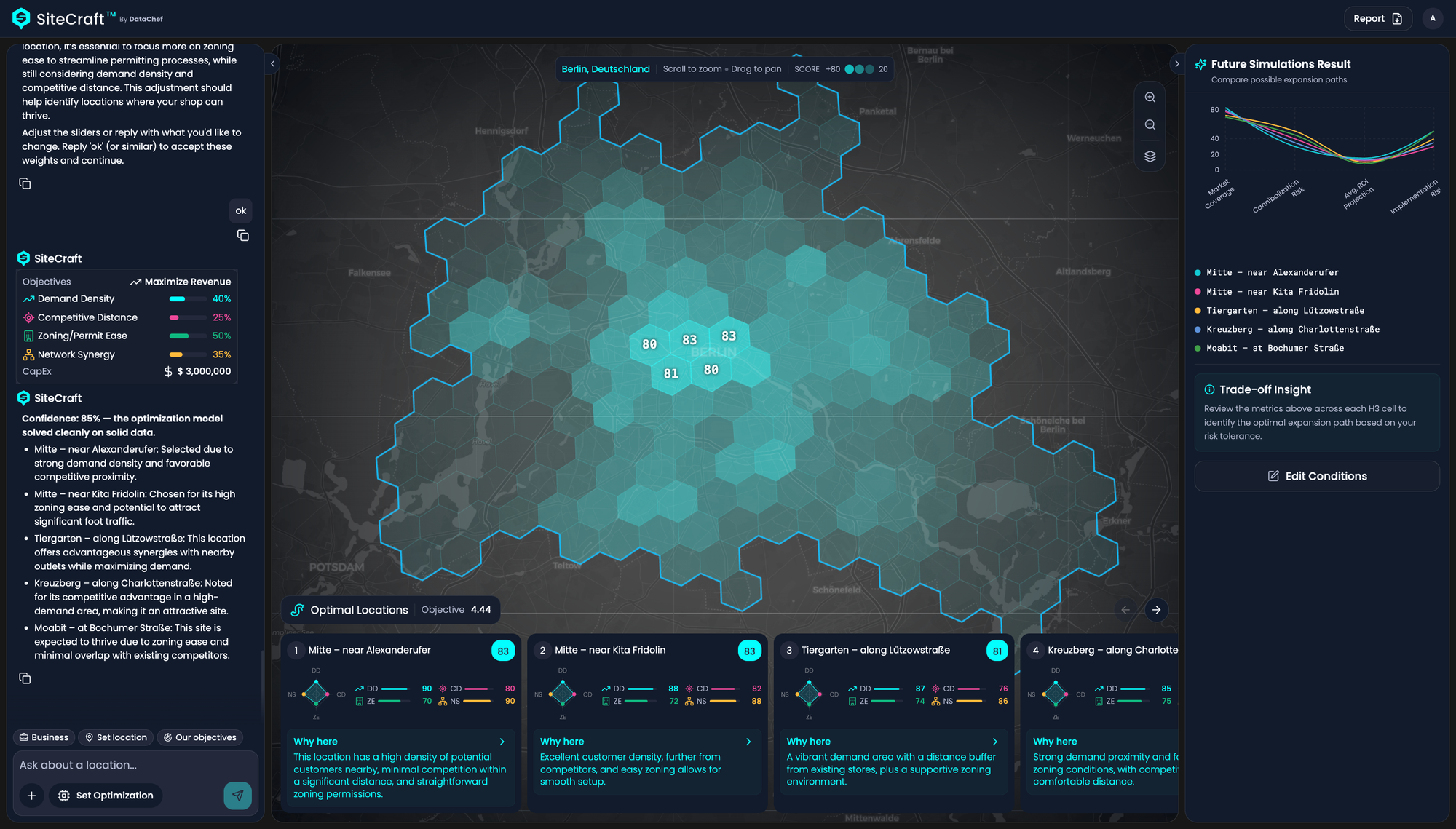
Every hexagonal cell on SiteCraft's map — rendered using the H3 geospatial indexing system at sub-500m resolution in urban areas — is scored in real time across four signals:
- Demand Density: foot traffic, resident density, tourist overlap, worker populations. Who is actually here, and when?
- Competitive Distance: proximity to direct and indirect competitors. Is the market already saturated, or is there room?
- Zoning & Permit Ease: commercial zoning classification, heritage zone constraints, permit processing timelines, neighbourhood demographics. Can you actually open here?
- Network Synergy: the benefit this location would bring to your existing store network. Does it fill a gap or create a cannibal?
As you move the viewport, the system recalculates. As you shift your optimization weights, the scores shift too. The map is not a static picture of the world. It's the live output of a model that knows your business.
2. A Model That Knows Your Business
SiteCraft models the world as your business sees it.
When you tell it you're targeting premium zoning areas with high tourist overlap and a maximum CapEx of £2.4M, it doesn't just filter a dataset — it reweights the entire scoring model and re-ranks every candidate location. Change the CapEx ceiling to £1.8M and the ranked list shifts. Increase the weight on Network Synergy and locations that complete your coverage gaps rise to the top.
It also works with the data you already have. You don't need a clean export from an enterprise data warehouse. Bring your slide deck from the last board meeting. Upload your market research reports. Share your site performance spreadsheets. SiteCraft extracts the signals it needs and folds them into the model. The bar for getting started is a conversation, not a data migration project.
Rather than requiring structured data exports, SiteCraft can ingest unstructured inputs — decks, reports, spreadsheets — and extract the signals it needs. This means you can start with what you already have, not with what you wish you had.
3. Decision Transparency: Ask Why
When SiteCraft recommends Alexanderplatz over Kreuzberg, it doesn't just show you a score of 94 versus 92. It opens a Decision Transparency view that explains its full reasoning:
You: "Why is Alexanderplatz ranked above Kreuzberg?"
SiteCraft: "Triple-layer traffic — morning commuters heading to tech hubs, midday tourists and destination shoppers, evening nightlife crowds — creates a 24/7 demand profile that no single-use location can match. Score: 94. Confidence: 92% — there's uncertainty in weekend evening foot traffic data, and that's been factored in here.
Kreuzberg scores 92. The gap comes from Competitive Saturation: demand is massive, but so is existing supply. Alexanderplatz has more demand relative to competition in the catchment. CapEx estimate: £2.4M, based on the commercial rental market in the area."
Every step is legible. Every assumption is surfaced. You can push back, adjust, and decide whether you agree. That's not what optimization engines do. It's what good consultants do.
4. Future Simulations: Model the Risk Before You Commit
Before committing to a location, SiteCraft lets you model the scenarios that keep you up at night:
- What happens to your network's market coverage if rents grow 20% across Mitte over the next three years?
- If a major competitor opens five new stores in Kreuzberg, how does that change the competitive distance scores for your shortlisted sites?
- In a value-driven consumer environment, does the premium zoning weight in your model still make sense?
SiteCraft runs these scenarios and returns results across four metrics — Market Coverage, Cannibalization Risk, Average ROI Projection, and Implementation Risk — for each candidate location in your analysis area. You see the scenarios side by side. You decide how much risk you're willing to take.
What Your Teams Get
- Ranked recommendations, not ranked data: SiteCraft tells you which location to open, backed by a transparent scoring model you can interrogate and defend — not a list of candidates to evaluate manually.
- Explainable decisions: Every recommendation comes with a full breakdown of the signals, weights, and reasoning that produced it. You can challenge any assumption, and the model responds.
- Configurable business logic: Signal weights, CapEx ceilings, zoning preferences, network synergy targets — all configurable without writing code. The model adapts to your criteria, not the other way around.
- Bring your own data: Upload site performance data, market research, or planning reports. SiteCraft extracts the signals it needs and incorporates them into the scoring model.
- Scenario modelling before commitment: Pressure-test your shortlist against future market conditions before signing a lease. See how each location performs across optimistic, base, and downside scenarios.
- Confidence levels, not false precision: When data is uncertain, SiteCraft says so — you see the confidence level alongside every recommendation and the specific gaps driving it.
Who SiteCraft is For
SiteCraft is built for operators who are serious about expansion and need their location decisions to be defensible, not just data-informed.
Retail chains
evaluating 10–50 new sites per year
Replaces consultant-led review cycles with a live scoring model that runs on your own criteria. A single bad location decision costs millions in fit-out, rent, and lost revenue over the lease term.
Franchise networks
managing location approval across hundreds of franchisees
Gives franchisees and regional managers a consistent, explainable model for site evaluation. Consistency and explainability matter as much as the recommendation itself.
Food and beverage groups
in dense urban markets
Models network synergy and competitive saturation at the city-block level. The difference between a great site and a terrible one is often 500 metres — and a single cannibalising location can erode the network's overall performance.
Real estate and development teams
Surfaces demand density, zoning complexity, and permit ease in a single interface — before commissioning a full feasibility study.
If your location decisions currently live in spreadsheets reviewed by consultants in quarterly meetings, SiteCraft is built for you.
If you've bought a data platform and found that it gives you better questions, not better answers, SiteCraft is built for you.
If you've used an optimization engine and found that you don't trust the output because you can't see how it got there, SiteCraft is built for you.
Conclusion
Location decisions are some of the most consequential choices a multi-location business makes. And for too long, the tools available have been either too narrow (datasets that give you facts but not decisions), too opaque (optimization engines that give you answers but not reasoning), or too slow (consultants who give you recommendations but not agility).
SiteCraft changes that. Not by giving you more data, but by turning your data, your constraints, and your business logic into a live model that scores, ranks, and explains every candidate location — so that when the decision comes, it's informed by everything the data can offer.
Interested in SiteCraft or evaluating how your expansion decisions are made today? Reach out to us at datachef.co/contact or connect with us on LinkedIn.
#location-intelligence #retail-expansion #franchise #prescriptive-analytics #geospatial-ai